
In the world of maritime transportation, the terms “vessel” and “ship” are often used interchangeably. However, while they share similarities, they are not exactly the same. Understanding the differences between a vessel and a ship is essential for professionals in logistics, shipping, and marine operations.
This article breaks down their meanings, key differences, and practical uses in international shipping.
What Is a Vessel?
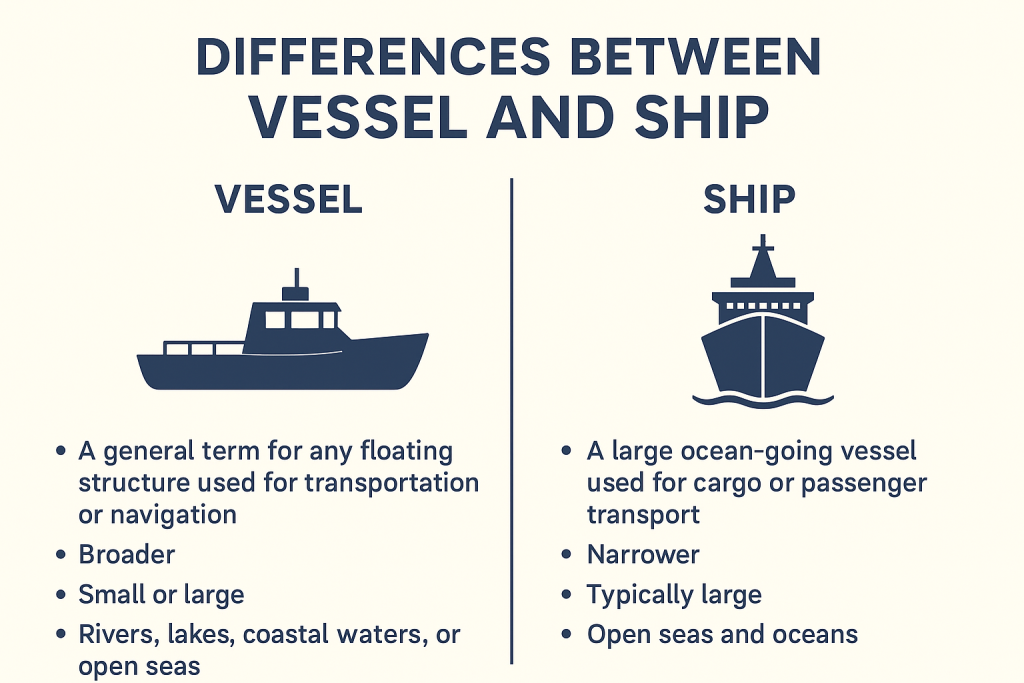
A vessel is a broad term that refers to any watercraft capable of transporting people or goods over water. This includes ships, boats, barges, ferries, submarines, yachts, and even offshore drilling platforms.
In legal and maritime contexts, “vessel” is the preferred general term. For example, the International Maritime Organization (IMO) and most maritime laws use “vessel” to describe all floating structures used for navigation or transport.
Examples of Vessels:
Cargo ships and container vessels
Oil tankers and LNG carriers
Passenger ferries and cruise ships
Fishing boats
Naval submarines
Offshore platforms
What Is a Ship?
A ship is a specific type of vessel — usually large, ocean-going, and self-propelled — designed for the transportation of cargo or passengers across seas and oceans.
Ships are built to handle long-distance navigation, equipped with complex systems for propulsion, navigation, and cargo handling.
Common Types of Ships:
Container Ships – for transporting containerized cargo
Bulk Carriers – for carrying unpackaged goods like coal or grain
Tankers – for transporting liquid cargo such as oil or chemicals
Passenger Ships – including cruise liners and ferries
Naval Ships – used for defense and maritime security
Key Differences Between Vessel and Ship
| Category | Vessel | Ship |
|---|---|---|
| Definition | A general term for any floating structure used for transportation or navigation | A large ocean-going vessel used for cargo or passenger transport |
| Scope | Broader — includes all types of watercraft | Narrower — a subset of vessels |
| Size | Can be small or large | Typically large |
| Operation Area | Rivers, lakes, coastal waters, or open seas | Mainly open seas and oceans |
| Crew Requirement | Smaller crew or sometimes unmanned | Requires a professional crew and officers |
| Purpose | Varies: fishing, transport, leisure, military, or industrial | Primarily commercial or military transport |
| Example | Fishing boat, barge, yacht | Container ship, oil tanker, cruise ship |
Legal and Industry Usage
In maritime law, “vessel” is the official and comprehensive term used in contracts, insurance policies, and safety regulations. For example, Bill of Lading documents and Marine Insurance policies often refer to the “vessel name” rather than “ship name.”
However, in common speech or shipping operations, “ship” is more specific — referring to large cargo carriers or naval fleets.
Why Understanding the Difference Matters
For logistics professionals, freight forwarders, and shipping companies, knowing when to use “vessel” versus “ship” ensures:
Accurate documentation in shipping contracts and customs declarations
Clear communication with carriers, ports, and clients
Compliance with maritime and insurance regulations
Conclusion
In short, all ships are vessels, but not all vessels are ships.
A vessel is any floating craft that can move on water, while a ship is a large, ocean-going vessel used primarily for transportation or military purposes.
Understanding this distinction not only improves communication but also helps maintain accuracy in maritime operations, logistics documentation, and international trade.
