The Middle East has long been one of the most critical maritime crossroads in global trade — linking Asia, Europe, Africa, and the Americas through vital sea routes like the Suez Canal, the Strait of Hormuz, and the Bab el-Mandeb Strait. In early 2026, a sharp escalation of conflict in the region has dramatically reshaped shipping routes, port operations, and logistics planning worldwide. What was once a relatively stable network of trade lanes has become a high-risk zone with deep implications for global supply chains.
1. Traditional Middle East Maritime Routes
Historically, the key sea routes in and around the Middle East include:
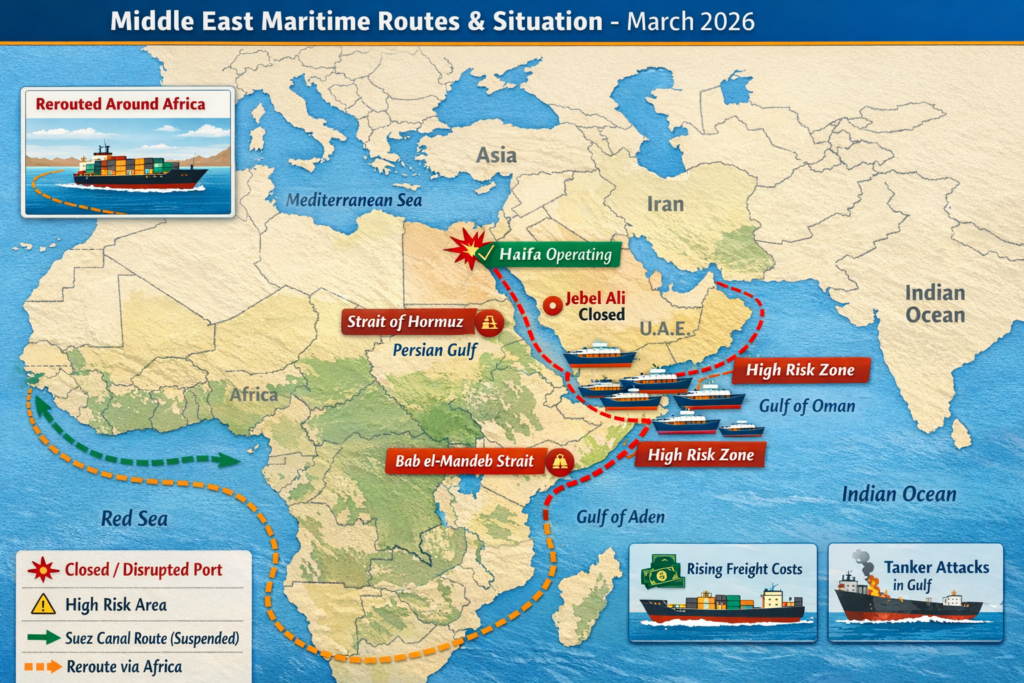
Suez Canal & Red Sea Route: The fastest commercial corridor connecting Europe and Asia. Ships from East Asia calling at Middle East, African, or European ports often transit this canal to significantly reduce voyage times.
Hormuz Route (Persian Gulf): The essential energy-cargo passage for exports from Saudi Arabia, Kuwait, UAE, Iraq, Qatar, and Iran. Roughly 20% of global oil and LNG shipments pass through this chokepoint.
Bab el-Mandeb (Gulf of Aden): The southern gateway from the Red Sea to the Indian Ocean and onward to Asia.
These routes also serve millions of containers and bulk cargoes beyond hydrocarbons — making the Middle East not just an energy hub but a linchpin of global commerce.
2. Recent Disruptions: Geopolitical Tensions Reshape Shipping
March 1–2, 2026 saw a significant escalation in conflict between the United States, Israel, and Iran, extending beyond land and air confrontations into the maritime domain. This has triggered urgent operational responses from carriers and ports.
A. Rerouting & Suspended Transits
Major container shipping companies including Maersk, CMA CGM, and MSC have announced significant changes:
Rerouting Around Africa: Due to the deteriorating security situation — particularly threats in the Bab el-Mandeb Strait and the Persian Gulf — Maersk has paused future sailings through the Suez and is diverting major services such as ME11 and MECL around the Cape of Good Hope. This extends transit times significantly and increases costs.
Suspension of Bookings & Gulf Traffic: MSC has suspended worldwide cargo bookings to the Middle East and instructed ships to shelter in safer ports until further notice.
Security Advisories: Greece and other maritime authorities have warned vessels to avoid the wider Persian Gulf, Strait of Hormuz, Gulf of Oman, and adjacent waters due to threats including missile and drone attacks, GPS interference, and harassment.
This represents one of the most disruptive periods for Middle East sea routes since the Houthi-linked Red Sea threats of 2021–2024, and it has forced a rapid rethink of routing strategies across the industry.
B. Anchored Fleets & Supply Chain Slowdowns
Shipping data shows hundreds of vessels — including crude oil and LNG tankers — have dropped anchor outside the Strait of Hormuz or along Gulf coastlines due to fears of attack or interdiction. Insurance firms have even withdrawn coverage for vessels transiting these waters, signaling the severity of the risk environment.
At least three tankers were damaged and a seafarer killed amid attacks in Gulf waters, underscoring the very real danger to commercial shipping.
3. Port-by-Port Situation in the Middle East
The conflict’s ripple effects have directly impacted several major Middle Eastern ports:
A. United Arab Emirates & Dubai
Jebel Ali Port, the largest container hub in the Gulf, has temporarily suspended operations after debris from aerial actions triggered a fire and forced emergency measures. This disruption at a key re-export and transshipment hub creates delays across regional logistics networks.
Other UAE ports are facing partial closures and operational restrictions as authorities prioritize safety and monitor maritime threats.
B. Strait of Hormuz Ports (Oman, UAE, Qatar, Kuwait)
Ports along the Strait of Hormuz are in a state of heightened alert. Some vessels have attempted transit, but many have been advised to avoid the strait pending clearer security conditions.
Anchoring congestion off these ports is growing as shippers await safe passage, leading to delays in discharge and loading activities.
C. Israeli Ports
Despite the turbulence, Haifa Port in Israel reports that its infrastructure remains fully operational and secure, underscoring selective resilience amid wider regional turmoil.
D. Red Sea & Suez Region
The Red Sea remains sensitive to further escalation, though for now the primary concern involves threats that could spill into these corridors. Previously, carriers had resumed navigation here after calmer periods, but recent events have made firms hesitant to recommit fully.
4. Economic and Global Shipping Impacts
Rising Freight & Insurance Costs
With increased risk premiums in the Gulf and longer voyages around Africa, shipping costs and war-risk insurance surcharges are rising sharply. Carriers like Hapag-Lloyd have introduced war risk surcharges for cargo in the Persian Gulf region beginning March 2, 2026.
Oil Transportation & Tanker Rates
The anxiety surrounding the Strait of Hormuz has caused tanker rates, especially VLCC (Very Large Crude Carrier) charter rates, to spike. Reports indicate VLCC daily rates have climbed above US$200,000, highlighting how political uncertainty can drive up transport costs.
Global Supply Chain & Energy Costs
Disrupted Middle East shipping routes directly affect global energy markets. The closure or avoidance of Hormuz can restrict roughly one-fifth of global oil flows, which in turn drives up fuel prices and shipping costs worldwide.
5. What This Means for 2026 & Beyond
The current situation is likely to have long-lasting implications:
Shipping route diversification may become a strategic priority — including broader use of the southern Africa detour and investments in alternative corridors.
Port development strategies in the Middle East might shift, focusing on resilience and security reinforcements.
Digital maritime insurance solutions and maritime risk analytics will be in higher demand to help carriers navigate volatile waters.
In a world where maritime trade remains the backbone of the global economy, the Middle East situation in 2026 has once again underscored the inseparable link between geopolitics and global shipping. Carriers, ports, and global supply chains must now adapt rapidly to a new normal that blends commercial imperatives with heightened security dynamics.