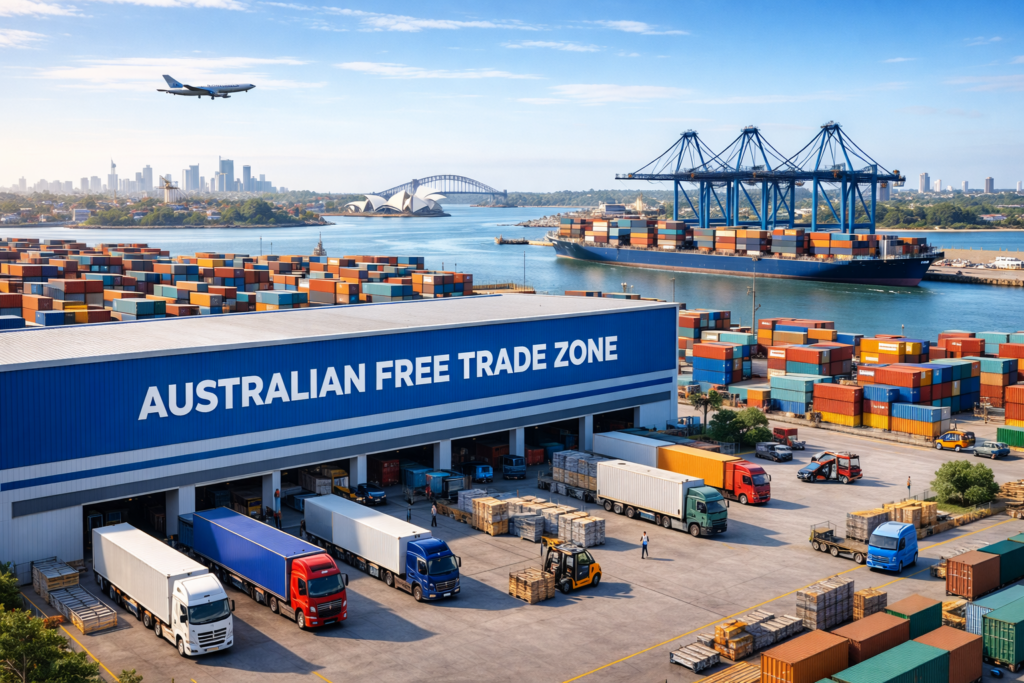
Australia is widely recognized as one of the world’s most open and trade-oriented economies. While it does not operate traditional “free trade zones” in the same way some countries do, Australia has built one of the most comprehensive Free Trade Agreement (FTA) networks globally. This network plays a critical role in shaping Australia’s position as a strategic gateway for international trade, manufacturing, and supply chain integration.
For exporters, manufacturers, and global buyers, understanding Australia’s free trade framework is essential to unlocking tariff advantages, reducing compliance risks, and improving market access across the Asia-Pacific and beyond.
1. Understanding Australia’s Approach to Free Trade
Unlike countries that rely heavily on geographically defined free trade zones, Australia’s trade liberalization strategy is centered on bilateral and multilateral free trade agreements. These agreements focus on:
- Eliminating or reducing tariffs
- Simplifying customs procedures
- Establishing clear rules of origin
- Enhancing transparency and legal certainty
- Facilitating services, investment, and digital trade
This approach allows Australian businesses to access global markets without being limited to specific zones or ports, while giving foreign partners confidence in Australia’s stable regulatory and legal environment.
2. The Scope of Australia’s Free Trade Agreement Network
Australia currently has over 18 free trade agreements in force, covering more than 80% of its total trade value. These agreements span major global economies and key growth regions.
Major Trade Partners Include:
- China (ChAFTA)
- Japan (JAEPA)
- South Korea (KAFTA)
- United States (AUSFTA)
- New Zealand (CER Agreement)
- ASEAN countries (AANZFTA)
- United Kingdom (Australia–UK FTA)
In addition, Australia is a core member of mega-regional agreements that are reshaping global trade patterns.
3. Key Regional Agreements Shaping Australia’s Trade Influence
RCEP – The World’s Largest Free Trade Agreement
The Regional Comprehensive Economic Partnership (RCEP) connects Australia with China, Japan, South Korea, ASEAN nations, and New Zealand. Together, these economies account for roughly 30% of global GDP and population.
RCEP offers:
- Unified rules of origin across multiple markets
- Gradual tariff elimination on thousands of products
- Improved supply chain flexibility for manufacturers
- Reduced administrative burden for exporters
For manufacturers operating across Asia-Pacific supply chains, RCEP significantly lowers the cost of regional production and trade.
CPTPP – High-Standard Trade Liberalization
The Comprehensive and Progressive Agreement for Trans-Pacific Partnership (CPTPP) is another cornerstone of Australia’s trade policy. It includes economies such as Japan, Canada, Mexico, Vietnam, and Chile.
CPTPP is notable for:
- High standards on labor, environment, and IP protection
- Strong disciplines on state-owned enterprises
- Advanced rules for digital trade and e-commerce
This agreement strengthens Australia’s position as a trusted trade partner for high-value manufacturing and technology-driven industries.
4. Benefits of Australia’s Free Trade Network for Businesses
1. Tariff Reduction and Cost Savings
Many Australian exports enjoy zero or near-zero tariffs in FTA partner markets. This improves price competitiveness and margins for exporters and manufacturers.
2. Supply Chain Stability
Australia’s agreements reduce policy uncertainty, which is crucial for long-term supply chain planning and investment decisions.
3. Simplified Rules of Origin
Harmonized rules make it easier for products manufactured with multi-country inputs to qualify for preferential treatment.
4. Strong Legal and Regulatory Environment
Australia’s FTAs are backed by a transparent legal system, minimizing risks related to contract enforcement and dispute resolution.
5. Australia as a Manufacturing and Export Base
Although Australia is not traditionally known as a low-cost manufacturing hub, its FTA network enhances its role in high-quality, compliance-driven manufacturing, especially in sectors such as:
- Industrial equipment
- Medical devices
- Pool and water treatment equipment
- Food and agricultural products
- Advanced materials and components
Products manufactured or substantially transformed in Australia can gain preferential access to multiple markets simultaneously, making Australia an attractive base for value-added production and final assembly.
6. Implications for Importers and Global Buyers
For overseas buyers, sourcing from Australia offers several advantages:
- Reduced import duties under applicable FTAs
- High product standards and strict quality controls
- Transparent compliance and documentation practices
- Lower risk of trade disputes or sudden policy changes
This is particularly important for industries where product reliability, safety, and long-term performance are critical.
7. Compliance and Rules of Origin: A Critical Consideration
To benefit from Australia’s free trade agreements, exporters must comply with rules of origin requirements, which typically involve:
- Local content thresholds
- Substantial transformation criteria
- Proper certification and documentation
Incorrect origin claims can lead to denied preferences, penalties, or reputational damage. As a result, many manufacturers invest in robust compliance systems and trade documentation processes.
8. Australia’s Strategic Role in Asia-Pacific Trade
Geographically positioned between Asia and the Pacific, Australia acts as a bridge economy, connecting developed and emerging markets. Its FTA network reinforces this role by enabling smoother trade flows between:
- East Asia and Oceania
- Southeast Asia and Western markets
- Resource-exporting and manufacturing economies
As global supply chains continue to diversify away from single-country dependence, Australia’s stable trade framework becomes increasingly valuable.
9. Future Outlook: Expansion and Modernization
Australia continues to expand and modernize its trade agreements, with ongoing discussions and upgrades focused on:
- Digital trade facilitation
- Green and sustainable supply chains
- Services and investment liberalization
- Small and medium enterprise (SME) participation
These developments aim to keep Australia competitive in an evolving global trade landscape.
Conclusion: Why Australia’s Free Trade Network Matters
Australia’s free trade agreements are far more than tariff reduction tools—they are strategic instruments that enhance trust, efficiency, and resilience in global commerce.
For manufacturers, exporters, and international buyers, Australia’s FTA network offers:
- Predictable market access
- Reduced trade costs
- Strong compliance credibility
- Long-term partnership potential
In an era of shifting trade policies and geopolitical uncertainty, Australia stands out as a reliable, rules-based trading partner—making its free trade network a powerful asset for businesses operating on a global scale.