A Practical Decision Guide from Freights Logistics
For Amazon FBA sellers, ocean freight is not simply about transporting goods from one port to another. It directly impacts inventory turnover, cash flow, storage costs, and peak-season stability.
One of the most frequent questions we receive at Freights Logistics is:
Should I ship Full Container Load (FCL) or Less than Container Load (LCL) for my FBA replenishment?
There is no universal answer. The right decision depends on shipment volume, product value, sales forecast, seasonality, and risk tolerance. In this guide, we break down the selection logic, cost comparison, and hidden operational risks to help you make the most strategic choice.
Understanding the Core Difference: Efficiency vs. Flexibility
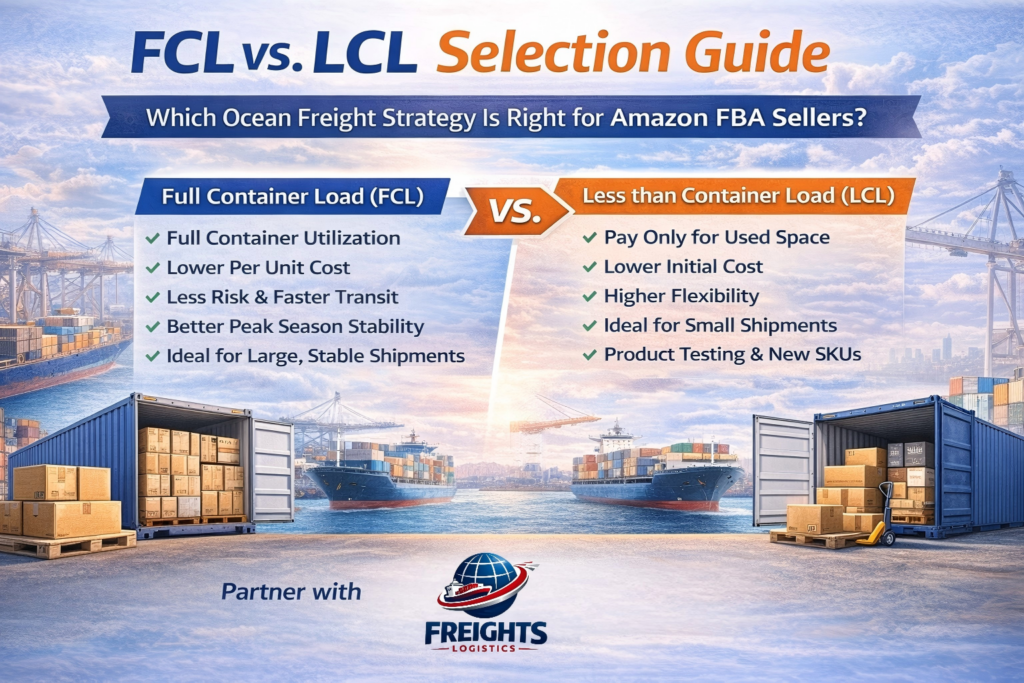
At its core, the difference between FCL and LCL comes down to volume efficiency versus operational flexibility.
- FCL (Full Container Load) = You book an entire container.
- LCL (Less than Container Load) = You share container space with other shippers.
Each option serves different business scenarios.
When FCL Is the Better Choice
Ideal Conditions for FCL
FCL works best for sellers who have:
- Shipment volumes approaching container capacity
- Stable and predictable sales velocity
- Peak-season replenishment needs
- High-value or fragile products
- Strong time-sensitivity requirements
Typical container capacities:
- 20GP: approximately 28–30 CBM
- 40HQ: approximately 65–68 CBM
When shipment volume is high or delivery stability is critical, FCL usually provides superior operational control.
Operational Advantages of FCL
With FCL, your cargo occupies the entire container. This offers several benefits:
- No cargo mixing
- Fewer handling stages
- Lower risk of damage or carton loss
- More predictable transit schedules
- Faster customs clearance
- Direct delivery scheduling
During Amazon peak seasons (Q3–Q4), FCL becomes even more advantageous. Space availability is more secure, consolidation delays are minimized, and sailing schedules are generally more stable.
For sellers preparing inventory for Prime Day or Black Friday, the added reliability of FCL often outweighs minor cost differences.
At Freights Logistics, we coordinate container loading optimization, priority vessel booking, and port-to-Amazon warehouse delivery scheduling to reduce appointment delays and operational uncertainty.
When LCL Makes More Sense
Ideal Conditions for LCL
LCL is typically suitable when:
- Shipment volume is under 15 CBM
- Testing new SKUs
- Conducting small-batch replenishment
- Managing tight cash flow
- Shipping during off-season periods
Instead of paying for unused container space, you only pay for the space you use.
For new products or uncertain demand forecasts, LCL reduces upfront capital commitment and inventory exposure.
Operational Characteristics of LCL
LCL shipments are charged by volume or weight (whichever is greater).
Industry standard conversion: 1 CBM ≈ 167 KG.
However, LCL involves:
- Consolidation at origin
- Deconsolidation at destination
- Additional warehouse handling
- More operational touchpoints
These extra handling steps increase processing time and slightly elevate the risk of carton damage.
At Freights Logistics, we operate controlled consolidation warehouses to ensure clear cargo separation, accurate labeling, and reduced handling risk.
Cost Comparison: FCL vs. LCL
Freight rate comparison must go beyond ocean freight alone. Total landed cost includes origin fees, destination charges, and operational risk factors.
FCL Cost Structure
- Fixed rate per container
- Typically includes ocean freight, terminal handling, documentation
- No consolidation or deconsolidation fees
- Lower per-CBM cost as container utilization increases
The closer your shipment is to full container capacity, the lower your cost per unit.
LCL Cost Structure
- Charged per CBM or per ton
- Additional fees may include:
- Consolidation charges
- Export customs clearance
- Destination deconsolidation
- Port handling fees
- Potential warehouse storage
On a per-CBM basis, LCL is usually more expensive than FCL.
Volume-Based Decision Scenarios
Low Volume (<15 CBM)
LCL is generally more economical.
You avoid paying for unused container space, and total cost may be significantly lower than FCL.
Medium Volume (15–25 CBM)
This is the decision zone.
On certain trade lanes—especially during peak season—FCL per-CBM cost may become comparable to or even lower than LCL.
At this range, sellers should compare:
- Total landed cost
- Destination handling fees
- Delivery timeline
- Risk tolerance
Freights Logistics provides side-by-side cost simulations to support data-driven decisions.
High Volume (≥25 CBM)
FCL usually becomes clearly advantageous.
Per-CBM costs are often 10–30% lower than LCL, with:
- No consolidation queue
- Reduced peak-season surcharges
- Improved delivery scheduling reliability
For established Amazon sellers with stable sales, FCL is typically the long-term optimized strategy.
Hidden Costs and Risk Factors
Freight rate alone does not determine total cost.
Hidden Risks in FCL
- Underutilized container space
- Incorrect container size selection
Solution: Optimize container loading plans before booking.
Freights Logistics offers loading simulations to maximize utilization and reduce wasted space.
Hidden Risks in LCL
- Destination deconsolidation fees
- Warehouse storage due to appointment delays
- Peak-season consolidation waiting time
- Higher risk of damage
- Split delivery complications
Since LCL cargo must be sorted and redistributed upon arrival, additional handling increases operational complexity.
For fragile or high-value products, even minor damage can offset initial savings.
Strategic Recommendations
✔ Shipment ≥20 CBM or Stable Replenishment
Choose FCL for lower unit cost and higher reliability.
✔ Shipment <15 CBM or Product Testing Phase
Choose LCL for flexibility and reduced financial risk.
✔ High-Value or Fragile Goods
Prioritize FCL for cargo protection.
✔ Time-Sensitive Restocking
FCL offers more predictable transit schedules.
Why Amazon Sellers Partner with Freights Logistics
At Freights Logistics, we go beyond freight booking. We provide:
- FCL and LCL route comparison analysis
- Landed cost simulation modeling
- Amazon FBA compliance consultation
- Container loading optimization
- Consolidation services in major Chinese ports
- Customs clearance coordination
- Amazon warehouse appointment management
Ocean freight decisions directly impact inventory turnover, cash flow, storage fees, Buy Box stability, and seasonal performance.
Choosing between FCL and LCL is not just a logistics decision—it is a business strategy decision.
There is no universal answer to FCL vs. LCL. The right choice depends on shipment volume, product characteristics, sales forecast, seasonality, and operational priorities.
At Freights Logistics, we evaluate each shipment scenario individually to design the most cost-effective and risk-controlled solution for Amazon FBA sellers.
If you are planning your next FBA shipment, a structured FCL vs. LCL evaluation may reduce your total logistics cost by double-digit percentages while improving delivery reliability.
Freights Logistics – Professional Ocean Freight Solutions for Global E-commerce Sellers.