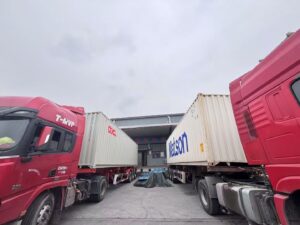

In Full Container Load (FCL) shipping, every cubic meter directly affects cost efficiency. Poor container planning leads to unused space, higher freight cost per unit, cargo instability, and increased transit risk. In contrast, professional container optimization can push space utilization beyond 95%, significantly lowering logistics expenses.
At Freights Logistics, we treat container loading not as a basic warehouse function, but as a strategic process that integrates engineering logic, cost control, and cargo safety management. In this guide, we outline practical strategies to maximize container capacity while minimizing wasted CBM in ocean freight operations.

1. Pre-Loading Planning: Accurate Calculation and Intelligent Design
Understand Container Types and Real Usable Dimensions
Effective loading begins with accurate measurement of usable internal dimensions, not theoretical container volume.
Approximate usable internal dimensions:
20GP (20-foot General Purpose)
5.89m × 2.35m × 2.39m
Usable volume: 28–30 CBM
40GP (40-foot General Purpose)
12.03m × 2.35m × 2.39m
Usable volume: 58–60 CBM
40HQ (40-foot High Cube)
12.03m × 2.35m × 2.69m
Usable volume: 65–68 CBM
However, actual usable space is reduced by:
- Door frame thickness
- Corrugated wall structure
- Floor reinforcement beams
Professional loading plans must consider these constraints.
At Freights Logistics, our operations team first determines whether a shipment is volume-driven or weight-driven before recommending the most cost-effective container type.
Standardize Cargo Dimensions
One of the most powerful ways to reduce CBM waste is to standardize outer carton dimensions.
Best practices include:
- Use consistent carton specifications
- Avoid irregular packaging whenever possible
- Accurately measure length × width × height and gross weight
- Follow stacking logic:
- Heavy goods at the bottom
- Light goods on top
- Large cartons below
- Smaller cartons above
Irregular packaging creates void spaces that reduce utilization and increase shifting risk.
Use Professional Loading Simulation Tools
Digital loading software such as LoadMaster or CargoWiz enables:
- 3D cargo arrangement simulation
- Optimal stacking calculation
- Space utilization forecasting
- Center-of-gravity analysis
With proper simulation, container utilization can exceed 95%, significantly reducing freight cost per CBM.
Freights Logistics integrates loading simulation into high-volume export planning, particularly for furniture, machinery, and e-commerce consolidation shipments.
2. Loading Techniques: Arrangement and Space Utilization Strategy
Core Arrangement Principles
Efficient container loading follows structural logic:
- Arrange cargo in rows along container length
- Minimize gaps between cartons and container walls
- Group identical-sized cartons together
- Stack rigid and heavy items at the bottom
- Utilize vertical space effectively
Random mixing of carton sizes inevitably creates unusable voids.
Gap Management Techniques
Even well-designed plans leave small residual gaps. Professional gap management improves both safety and utilization.
For small gaps:
- Fill with bubble wrap or cushioning materials
- Insert cardboard sheets for stabilization
For larger gaps:
- Use smaller cartons as fillers
- Rotate cartons to adjust alignment
- Reconfigure row placement strategically
Near the container doors, leave a controlled buffer zone to allow safe door closure without compressing cargo.
Special Cargo Optimization
Different cargo types require tailored loading strategies.
Extra-Long Cargo
- Position centrally along container length
- Secure both ends with wooden bracing
Over-Height Cargo
- Prioritize 40HQ containers
- Ensure total cargo height does not exceed structural limits
Irregular-Shaped Cargo
- Load standardized cartons first
- Use irregular items to fill corner spaces
At Freights Logistics, we combine structural engineering logic with practical warehouse execution to maintain cargo stability without sacrificing CBM efficiency.
3. Operational Execution: Turning Plans into Performance
Even the best loading plan fails without disciplined execution.
Before Loading: Preparation Determines Efficiency
Proper preparation includes:
- Inspect container interior for cleanliness and structural integrity
- Confirm floor and wall condition
- Mark loading sequence according to simulation plan
- Prepare wooden blocks, straps, anti-slip mats
Structured preparation reduces improvisation and protects loading accuracy.
During Loading: Maintain Structural Discipline
Execution control is critical:
- Follow the pre-approved loading plan
- Avoid changing sequence without recalculation
- Align cartons evenly per layer
- Prevent uneven stacking that creates voids
- Monitor weight distribution continuously
Balanced weight distribution is essential. The container’s center of gravity must remain centralized to prevent uneven axle pressure during trucking or instability during vessel operations.
At Freights Logistics, on-site supervisors ensure compliance with weight distribution standards to reduce risks of terminal rejection or transport incidents.
Final Inspection and Verification
After loading completion:
- Measure remaining empty space
- Confirm no significant unused volume
- Take detailed photo documentation
- Record stacking layout and CBM calculations
- Compare actual vs. projected volume
Ideally, variance should be controlled within 1–2 CBM.
This final verification strengthens cost accuracy and supports future optimization improvements.
Why Container Optimization Matters
Maximizing container utilization directly impacts:
- Cost per unit shipped
- Freight rate competitiveness
- Cargo stability and safety
- Reduced need for additional containers
- Lower carbon emissions per shipment
In competitive industries such as furniture, home appliances, machinery, and cross-border e-commerce, container efficiency can significantly improve supply chain margins.
The Freights Logistics Approach
At Freights Logistics, container optimization is embedded in our operational workflow:
- Detailed cargo data analysis before booking
- Simulation-based loading design for complex shipments
- On-site supervision for high-value cargo
- Strict weight distribution monitoring
- Photo documentation and compliance auditing
We view professional loading planning as a core value-added service—not merely a warehouse task.
In today’s volatile ocean freight market, where rates fluctuate and margins are tight, maximizing every cubic meter becomes a strategic advantage.
Efficient loading reflects operational discipline. Professional planning reduces cost uncertainty.
With Freights Logistics, your container space is not simply filled—it is optimized, secured, and strategically managed.